
One of the most important lessons I’ve learned as an investor is this:
You want to buy broken stocks.
Not broken companies.
There’s a big difference.
A broken stock is one where sentiment is weak, price action is ugly, and headlines are noisy.
A broken company is one where fundamentals are deteriorating, cash flow is shrinking, leadership is scrambling, and the long-term story is fading.
Right now, I believe we’re seeing a major rotation in the market. Big tech, software, and many growth stocks have been under pressure. Meanwhile, the broader indexes aren’t even down much year-to-date.
That tells me something important.
Capital is rotating. And when rotations happen, opportunities quietly form.
Here are 10 companies I believe are improving fundamentally, even if the stock price hasn’t fully reflected it yet.
SoFi ($SOFI)
SoFi continues to execute.
Membership growth remains strong. Deposits continue to scale, giving them lower-cost funding. And most importantly, profitability is now part of the story.
This is no longer just a “growth at all costs” fintech. It’s evolving into a diversified financial ecosystem with lending, banking, investing, and platform revenue.
The stock has been volatile. The business has not.
AMD ($AMD)
AMD has transformed from a turnaround story into a scaled semiconductor platform.
Revenue growth has been strong, margins are solid, and data center demand continues to drive long-term opportunity. AI and high-performance compute are not short-term trends.
They are structural shifts.
The stock may move with sentiment. The demand for compute is not going away.
Amazon ($AMZN)
Amazon remains one of the most diversified cash-generating machines in the world.
E-commerce, AWS, advertising, logistics, AI infrastructure — all working together.
Operating income and cash flow remain extremely strong. AWS continues to be a critical driver of profitability.
It’s easy to forget how powerful this business is when the stock consolidates.
Zeta ($ZETA)
Zeta is one of the more interesting small-cap growth names right now.
Revenue growth remains strong. Margins are improving. Free cash flow has turned positive.
The company sits at the intersection of data, AI-driven marketing, and personalization.
Small caps can be volatile. But when fundamentals improve and sentiment lags, that’s where asymmetric setups appear.
Oscar Health ($OSCR)
Oscar is still early in its maturity curve.
Membership growth continues. Cost discipline has improved. Margins are stabilizing.
Healthcare isn’t going away. Tech-enabled insurance still has room to scale.
The stock may not reflect the full turnaround yet, but the underlying trajectory has improved.
Salesforce ($CRM)
Salesforce remains deeply embedded in enterprise workflows.
Recurring subscription revenue, AI integration within the platform, and enterprise dependence create strong durability.
When enterprise tech sells off broadly, even high-quality platforms get hit.
That does not mean the business is broken.
Adobe ($ADBE)
Adobe continues to monetize creativity.
AI integration across Creative Cloud and Document Cloud has opened new pricing levers. Revenue growth remains solid. Margins are healthy.
This is not a company being replaced by AI. It is embedding AI into its ecosystem.
That’s a big distinction.
ServiceNow ($NOW)
ServiceNow quietly powers enterprise workflow automation.
Subscription growth remains consistent. AI is being integrated directly into workflows, not bolted on.
These are sticky systems of record businesses.
And sticky businesses tend to compound over time.
UnitedHealth ($UNH)
UnitedHealth is the steady anchor.
Massive revenue base. Strong free cash flow. Diversified exposure across insurance and health services through Optum.
Healthcare demand is structural, not cyclical.
The stock may deal with headline risk, but the business remains extremely durable.
Snap ($SNAP)
Snap is controversial, but it’s not irrelevant.
Massive engagement with Gen Z. Years of user data. Improving cost discipline.
The narrative has been weak. But engagement and attention still have value.
If monetization improves even moderately, sentiment can change quickly.
The Bigger Picture
Markets rotate.
Capital shifts.
Sectors fall out of favor.
But long-term wealth is built by identifying when sentiment disconnects from fundamentals.
Not every declining stock is an opportunity.
But when improving businesses trade like broken stories, that’s worth paying attention to.
The key is doing the work.
Looking beyond headlines.
Watching revenue trends, margins, cash flow, guidance, and execution.
Patience is required.
Personally, I focus on position sizing, conviction, and long-term time horizons.
I don’t need every stock to work immediately.
I need a few strong compounders over time.
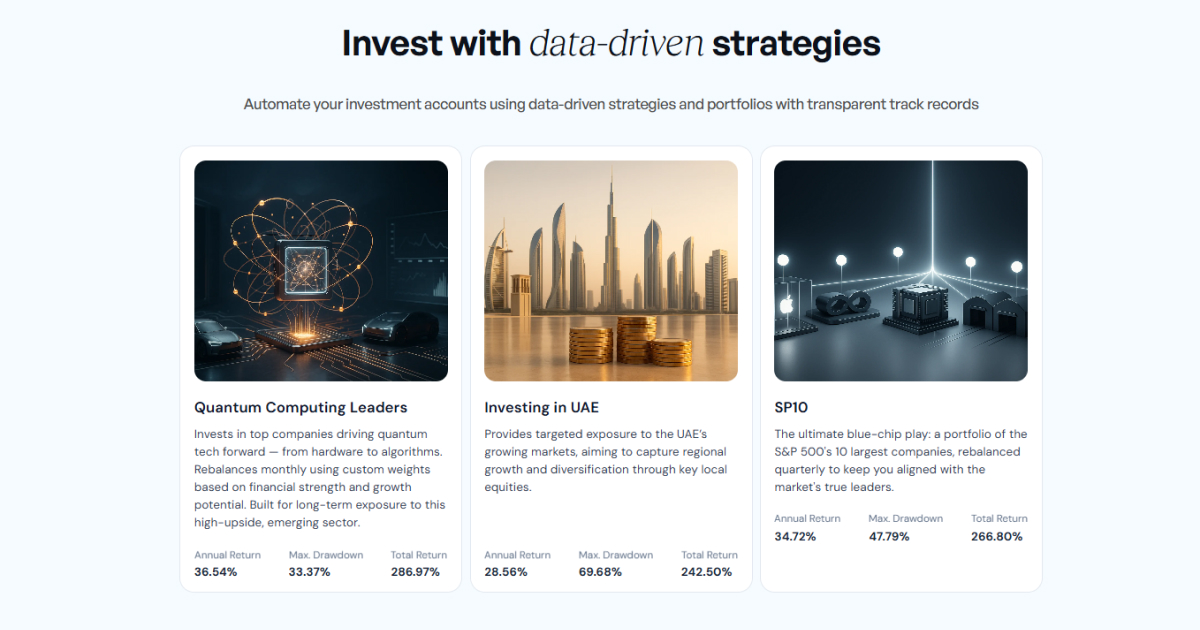
That’s also why I built my Surmount strategy.
It’s designed around high-quality growth and value names that meet specific financial filters. Revenue growth, improving margins, durable cash flow, and strong balance sheets.
If you want to follow along with how I systematically screen for these opportunities, you can check out my strategy on Surmount here:
The goal isn’t hype.
It’s process.
Final Thoughts
Buying broken stocks can feel uncomfortable.
But that discomfort is often where opportunity lives.
The difference is knowing whether the stock is broken…
Or the company is.
Do your research. Stay disciplined. Think long term.
And let time do the heavy lifting.
Disclaimer
This newsletter is for informational and educational purposes only and should not be considered financial advice. I am not a financial advisor. Investing involves risk, including the possible loss of principal. Always do your own research and consider your financial situation before making investment decisions. Opinions expressed are my own and subject to change without notice.
